
Flowers is the exquisitely dark ‘comedy drama’ about ‘home, family, and mental illness’ written and directed by Will Sharpe. He also plays one of the pivotal characters – Shun, who comes from Japan to live in the bizarre world of the very British and quite mad Flowers family.
Sharpe’s depiction of Shun is controversial though. Shun lives in a Hobbiton-like shack on the grounds of the Flowers’ home. He’s the illustrator to father Maurice Flowers’ disturbingly dark children’s books, and is treated like his side-kick – Shun is mostly a caricature of an emasculated man with an unconvincing Japanese accent.
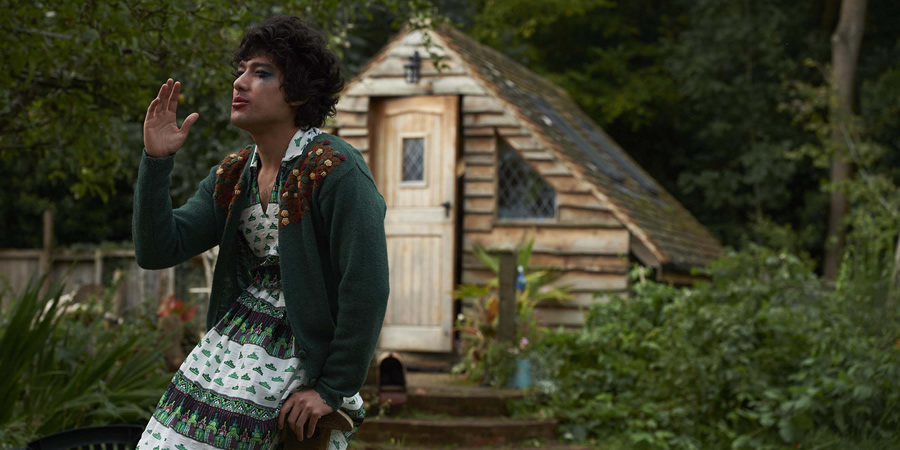
If I didn’t know better, I’d be railing at the stereotypes, but I understood instantly what Sharpe was doing with Shun. Like Sharpe, I left Japan when I was a kid, and if I had to depict a Japanese person in a non-Japanese context, I’d struggle, and end up like a caricature.
What Shun represents, at least to me, is the difficulty of straddling difference. That difference might be cultural, but in Flowers, the difference explored is mental illness. Maurice’s failed attempt at hanging himself is the opening scene, and the first season delves deeply into depression.
But in the second season, the woolly coats are replaced by vibrant coloured shorts and cotton dresses, as the narrative shifts to daughter Amy’s bipolar episodes – visceral, florid, bold, edgy, and there’s something life-affirming in these scenes. I suspect that’s because there’s little attempt to judge, to heal, to even to understand her illness. She’s just allowed to be, well…completely mad.
When Amy is crying and screaming that she hates herself and wants to die because she’s a horrible person, her family and girlfriend sit with her on the floor, telling her they love her. There’s a sense of desperation in their voices, as if they’re clinging to the words out of fear, so that ‘I love you’ feels hollowed out, devoid of meaning. Which makes sense to me.

Love is implicit in families, no matter how fucked up, and saying ‘I love you’ seems pointlessly excessive, more Hollywood and not quite British (or Japanese). And by making ‘I love you’ feel lame, love makes no demands on them (demands to recover, demands to explain), which opens up a space for Amy to just be. I felt like Amy was just being held in the mad, chaotic space.
Sharpe had already made his view of love clear near the end of the first season when Maurice, inarticulate with suffering, tries to explain his depression to his wife Deborah.
‘It’s like an invisible monster with no shape, no form but it’s loud and fierce and it never ends.’ When Deborah suggests, ‘maybe love is how we defeat this monster together…’, Maurice replies, ‘love makes it worse.’ And the more love, the worse it feels because there’s more love to disappoint.
Which is why many people with mental illness isolate themselves, just like the Flowers, who live at the end of a forest and seemingly endless cornfield. Sharpe’s vision of the Flowers’ universe feels so contained – there’s no sense of time, or the rest of the world, neighbours are invisible, and the part fairy tale, part Gothic setting entertain ‘real’ and imagined ghosts.
The family live together with their creative pursuits (son Donald has his inventions, Amy, her music) but are incapable of connecting without acting vile. Sharpe’s vision of their isolation is so complete.
The final episode of the series I think, touched me the most. It’s an epilogue in the form of a prologue, and tells the story of Shun arriving at the Flowers’ house from Japan. He brings with him a suitcase full of gifts like daifuku and yukata, but mostly emotional baggage.
Later, showing Maurice his illustrations, Shun tells Maurice in stilted English, ‘I like dark’. Shun goes on, ‘you help me, start again…because you feel…difference. Difference, alive and dead. So small. But if you can hold…’
Yes, the difference between alive and dead is small, and ‘if you can hold’, is a sentiment worth clinging to.
But I think the difference Shun is referring to is the difference people feel because of their mental illness. Despite society’s efforts to be more accepting, it is difficult, perhaps impossible to be true to this difference, to be authentic to a ‘mad’ self.
And for many people who have a lot of dark inside, Shun’s final words, ‘if you can hold…’ is a invitation to just hold the darkness and the madness, and to be true to the most difficult of differences, just for a moment. And that feels like liberation to me.
Flowers is a British series now showing on Netflix in Australia. There are 2 seasons
 MASAKO FUKUI
Leave a comment